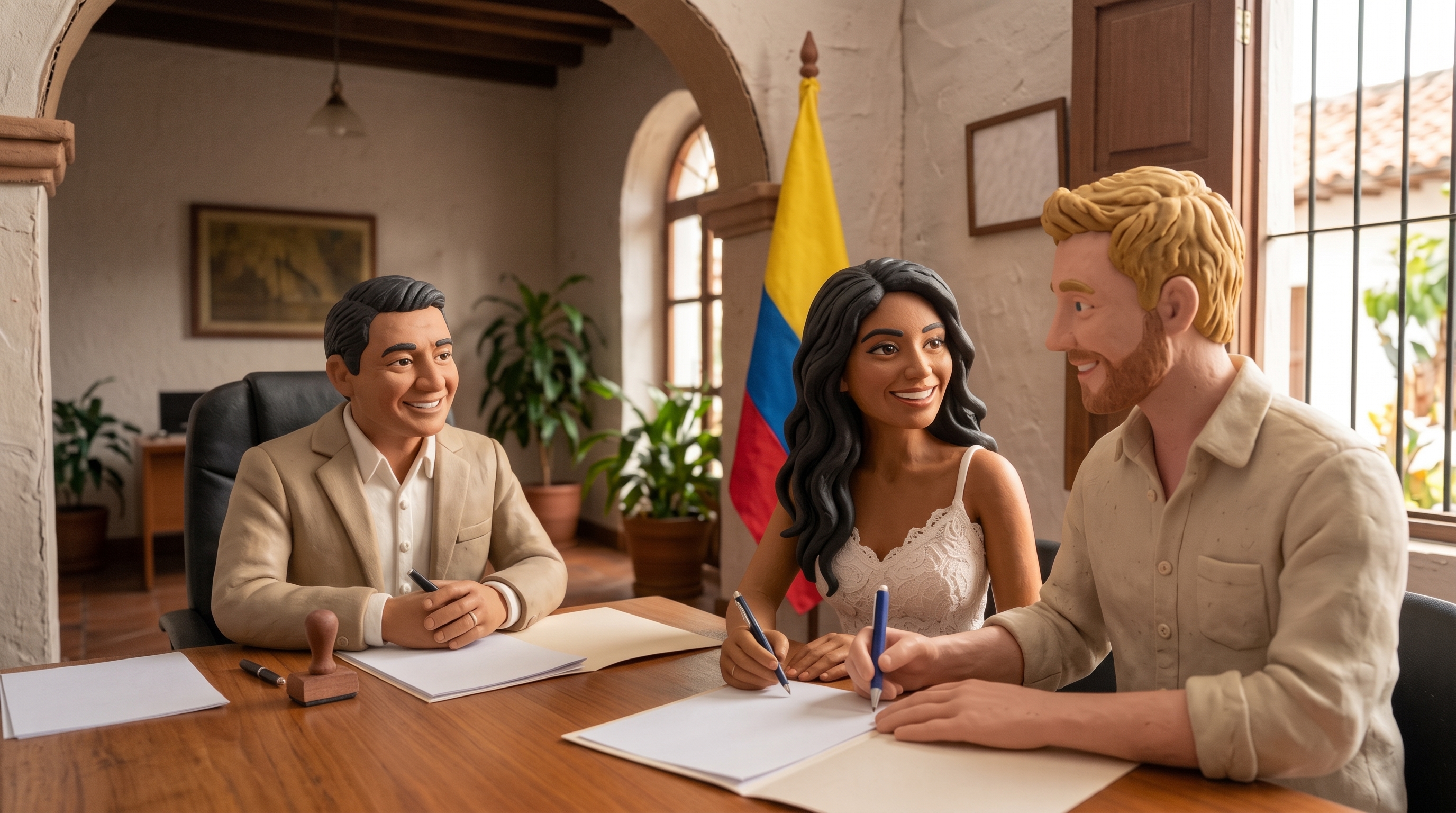
Legal Guide to Naturalization Under Law 2332 of 2023
For many foreign nationals, living in Colombia begins as a temporary stay or an investment opportunity and gradually evolves into a long-term home. As deep personal, professional, and economic roots are established, acquiring Colombian citizenship becomes a natural next step. Obtaining a Colombian passport grants full
- Author
- María Fernanda Duarte
- Published
- Reading time
- 7 min read

The process of naturalization in Colombia is governed by Article 96 of the 1991 Political Constitution and was recently updated by Law 2332 of 2023. This legislation established a modern framework defining how foreign residents can legally obtain Colombian nationality by adoption. Understanding these updated requirements, legal timelines, and procedural nuances is essential for any resident planning to undertake this journey.
1. Colombian Nationality: By Birth Versus By Adoption
To understand how a foreign national can acquire Colombian citizenship, it is important to distinguish between the two legal pathways recognized by the Constitution: nationality by birth and nationality by adoption.
Nationality by birth applies primarily to individuals born within Colombian territory who have at least one parent who is a Colombian citizen or a legally domiciled resident at the time of birth. It also applies to children born abroad to a Colombian parent once they are registered at a Colombian consulate or establish residency within the country.
Nationality by adoption—commonly referred to as naturalization—is a sovereign privilege granted by the Colombian state through the Ministry of Foreign Affairs (Cancillería). This status is available to foreign nationals who hold permanent residency, demonstrate meaningful integration into society, and fulfill the legal conditions set by Law 2332 of 2023. Additionally, Colombia allows naturalization through simplified pathways for native-born citizens of Latin American and Caribbean nations under international reciprocal agreements, as well as for indigenous individuals sharing border regions.
Importantly, Colombia recognizes dual nationality. Applicants acquiring Colombian citizenship by adoption are not required to renounce their original citizenship, allowing foreign nationals to preserve their native passports and legal rights in their home countries.
2. Qualifying for Naturalization: Residency Requirements and Timelines
The foundation of any naturalization application is holding a valid Permanent Resident Visa (Type R). Law 2332 of 2023 mandates that applicants must hold a Type R visa both at the time of application and throughout the entire legal proceeding. The continuous domicile required for citizenship begins on the exact date the Resident Visa is issued, not from the date of initial entry into the country under prior temporary visas. The required period of continuous residency varies according to the applicant's profile and family status:
• General Foreign Residents: Individuals who hold a Resident Visa based on investment, independent work, or extended residency must complete five (5) consecutive years of continuous domicile in Colombia before applying. • Family Ties to Colombian Citizens: Foreign nationals who are legally married to or in a recognized permanent union with a Colombian citizen benefit from a reduced requirement of two (2) years of continuous residency. The same shortened two-year timeline applies to foreign residents who are parents of Colombian children. • Nationals of Reciprocal Countries: Native-born citizens of Latin American and Caribbean countries, as well as Spanish nationals, may apply after completing two (2) years of continuous residency as Type R visa holders. • Recognized Stateless Persons: Individuals officially recognized as stateless by the Colombian government require only one (1) year of continuous residency and are exempt from naturalization application fees.
Maintaining physical presence during this qualification period is critical. Leaving Colombia for one (1) continuous year or more completely interrupts the domicile timeline, resetting the legal clock and requiring the applicant to restart their calculation.
3. Assembling the Application and Required Documentation
Applying for naturalization involves submitting a formal application dossier through the Ministry of Foreign Affairs' electronic portal. Each document must meet strict legal and authentication standards.
Applicants are required to draft a formal request letter addressed to the Minister of Foreign Affairs detailing their personal background, residency history, and grounds for seeking citizenship. This letter must be accompanied by a copy of a valid passport, a current Alien ID card (Cédula de Extranjería), and a valid Resident Visa.
A fundamental requirement is the submission of an official birth certificate that explicitly states the applicant’s date and place of birth. This document must be apostilled or legalized in the country of origin and accompanied by an official translation into Spanish if issued in another language. Applicants must also provide evidence of economic stability, such as proof of employment, tax records, or corporate ownership. Where applicable, applicants must include supporting documents demonstrating family ties, such as marriage certificates or the Colombian birth certificates of their children.
4. Knowledge Examinations and Statutory Exemptions
To ensure that naturalized citizens understand the civic structure of their new home, Law 2332 of 2023 requires applicants to pass comprehensive examinations testing their knowledge of the Colombian Constitution, national history, geography, and culture. Applicants from non-Spanish-speaking countries must also demonstrate language proficiency. These exams are organized and evaluated by the regional governor’s office (Gobernación) corresponding to the applicant’s place of residence. However, the law establishes specific statutory exemptions from these examinations: • Applicants over 60 years of age are automatically exempt from all naturalization exams. • Individuals who have obtained a high school diploma, undergraduate degree, or postgraduate degree directly from an accredited educational institution in Colombia are exempt from testing. (Note: Validating or convalidating a foreign degree in Colombia does not grant an exemption; the degree must have been earned directly within the Colombian educational system). • Officially recognized stateless individuals, members of indigenous border communities, and applicants with recognized cognitive disabilities are also exempt.
5. The Evaluation Process: Background Checks, Decision, and the Oath of Allegiance
Once the application and administrative fees are submitted, the Ministry of Foreign Affairs initiates a detailed legal and administrative review. Within three months, authorities assess the documentation for completeness. If any documents are missing or deficient, the applicant is granted six months to correct the application, with a possible one-time extension of three additional months.
As part of the evaluation, the Ministry requests confidential background and security reports from several state agencies, including Migración Colombia, the National Intelligence Directorate (DNI), and the tax authority (DIAN). These reports assess the applicant’s criminal record, tax compliance, and immigration background. An unfavorable security or criminal background report empowers the Ministry to deny the application without proceeding to further stages.
If the background reports are favorable and the examinations are passed or waived, the Ministry issues a favorable legal opinion (concepto favorable). The President of the Republic or the Minister of Foreign Affairs then signs the official decree granting citizenship (Carta de Naturaleza).
The final procedural step takes place at the local Mayor’s Office in the applicant's city of residence. The applicant must take a formal Oath of Allegiance to the Colombian Constitution and laws, or make a solemn affirmation for religious reasons. Once the oath is registered, the newly naturalized citizen can obtain their official Colombian ID card (Cédula de Ciudadanía) and apply for a Colombian passport.
6. Special Legal Provisions: Dependents, Discretionary Waivers, and Military Obligations
Law 2332 of 2023 includes several special provisions that address unique personal circumstances and legal obligations:
Extending Citizenship to Minor Children
Foreign parents applying for naturalization may concurrently request that citizenship by adoption be extended to their minor children residing in Colombia under a beneficiary Resident Visa. This request must be completed before the child reaches 18 years of age.
Presidential Discretion and Public Convenience
Under exceptional circumstances, the President of the Republic holds discretionary authority to partially waive naturalization requirements based on public convenience or notable contributions to the nation. Such requests must be backed by a formal letter from a Cabinet Minister, Ambassador, member of Congress, or recognized public figure highlighting the applicant's exceptional merits.
Military Service Obligations
Naturalized male citizens between 18 and 50 years of age are subject to regulations regarding national military service. However, statutory exemptions exist for individuals who are married, fathers, over 24 years old, have completed more than five academic semesters of higher education, or have already defined their military status in their home country. Revocation, Judicial Nullity, and Loss of Citizenship
Naturalization is subject to post-grant legal oversight. If an applicant fails to take the Oath of Allegiance within six months of the issuance of the Carta de Naturaleza without valid justification, the grant of citizenship is automatically revoked. Furthermore, citizenship by adoption may be annulled by judicial decree if it is proven that the application was based on fraudulent documentation or if the individual had committed extraditable offenses prior to naturalization. Finally, citizenship by adoption is lost upon conviction for crimes committed against state security or the constitutional regime.
Securing Your Path to Colombian Citizenship with Expert Legal Support
Obtaining Colombian citizenship is a rewarding milestone that secures your permanent place in the country. However, managing continuous residency timelines, preparing compliant legal documents, and navigating state agency reviews require careful planning to avoid administrative delays or rejections.
At Capital M Law, our immigration team brings deep expertise in guiding foreign residents through every stage of the naturalization process. Schedule a legal consultation with our team to review your residency history, evaluate your eligibility under Law 2332 of 2023, and build a seamless strategy toward acquiring your Colombian citizenship